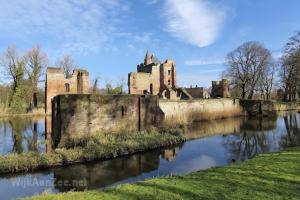
A fishing village without a harbour
Until the middle of the 19th century Wijk aan Zee en Duin was a typical fishing village, built among dunes that formed here around the year 1000.
- Dune fields: in the 10th and 11th centuries horseshoe shaped parabolic dunes formed around the village, and their sheltered hollows became fertile fields; the village meadow in the centre is the only surviving example.
- Sea village landscape: centuries of small fields and grazing by cows, sheep and goats created a special wealth of flowers around the village, which even got its own name: the zeedorpenlandschap.
- Son of a fisherman: the painter Rijckert Aertsz was born in Wijk aan Zee around 1482 as the son of a fisherman.
- The Dorpskerk: the late Gothic Dorpskerk is what remained of the much larger Sint Odulphuskerk; after Spanish troops took the roof beams for the siege of Alkmaar, the church was restored by the Protestants around 1600.
- No harbour: the fishermen pulled their boats up onto the beach, but when ever larger ships were needed in the 19th century, the village without a harbour lost out to the competition.
- Bitter poverty (1811): fishing slowly died out, and around 1811 many villagers trudged daily through the loose sand to Beverwijk to beg.

Bathers from Amsterdam
With the opening of the first bath hotel at the end of the 19th century, a whole new life began for Wijk aan Zee.
- The Badhotel (1881): the first Badhotel on the Zwaanstraat opened in 1881, and the villagers turned to welcoming bathers, mostly families from Amsterdam.
- Sleeping in the conservatory: guesthouse owners solved the lack of space by building conservatories onto their front facades, where the bathers could sleep.
- From bathing machine to bikini: the Zwaanstraat was extended to the beach; at first people were driven into the sea in a bathing machine, later they ventured onto the beach in bathing costumes.
- By tram to the sea: from 1882 to 1924 a tram ran between Beverwijk and Wijk aan Zee, first a steam tram and from 1892 a horse tram.
- Summer houses: wealthy Amsterdammers built their own summer homes on the southern edge of the village, and families who let their house moved into the little summer house behind it.
- Extra masses: until the 1970s the Catholic church held extra masses in summer in an annex, because the new Sint Odulphuskerk at the edge of the dunes was too small for all the bathers.
Neighbour of the Hoogovens
The construction of the North Sea Canal and the arrival of the steel industry changed the surroundings of Wijk aan Zee forever.
- A canal to the sea (1876): with the opening of the North Sea Canal in 1876, the port town of IJmuiden arose south of the village.
- Hoogovens (1918): on 20 September 1918 the Koninklijke Nederlandsche Hoogovens en Staalfabrieken was founded, located in the IJmond because of its position by the sea and the North Sea Canal.
- Hemmed in: since then Wijk aan Zee, apart from a single access road, has been enclosed by the steelworks (now Tata Steel), the North Sea and the Noordhollands Duinreservaat.
- Part of Beverwijk (1936): in 1936 the independent municipality of Wijk aan Zee en Duin ceased to exist and both villages became part of the municipality of Beverwijk.
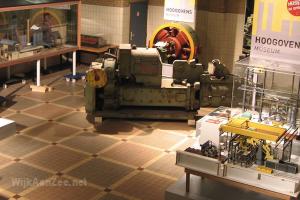
- Steel in the museum: at the Hoogovens Museum in Velsen-Noord you can discover more than a hundred years of steel production in the IJmond.
Atlantic Wall and evacuation
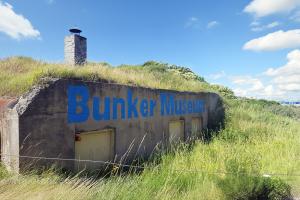
In the Second World War the coast around Wijk aan Zee became a heavily defended part of the German Atlantic Wall.
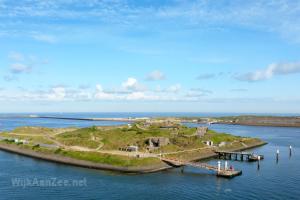
- Festung IJmuiden: between 1940 and 1944 the Germans built the Festung IJmuiden to protect the port and the blast furnaces, surrounded by minefields, anti tank ditches and roadblocks.
- Village evacuated (1942): in November 1942 all residents had to leave the village; in August 1943 they were allowed back at their own risk, but in October 1943 the village was evacuated again.
- A giant radar: on the dune ridge along the Van Ogtropweg stood a radar bunker with a twenty metre high screen, a so called Mammut, found at only four places in the Netherlands.
- The lost church bell: the bronze bell of the Dorpskerk from 1658 was taken away by the Germans, but the skipper deliberately sank his ship in the middle of the IJsselmeer; after the war the bell was raised and hung back in place.
- Return (1945): from 8 June 1945 the residents returned to their largely intact homes, after which German prisoners of war had to clear the minefields.
Chess village and day trips
After the war Wijk aan Zee became known mainly as a day beach for the region and as home to one of the strongest chess tournaments in the world.
- The Hoogovens tournament (1938): the first chess tournament was held in 1938 on the Hoogovens site; in 1942 it moved to Beverwijk and in 1946 it became international for the first time.
- Three names: until 1999 it was called the Hoogovens tournament, then the Corus tournament and since 2011 the Tata Steel Chess Tournament.
- Chess in De Moriaan: every January the world's best grandmasters play in the village hall De Moriaan, while thousands of amateurs, pupils and club players take part in the sports hall.
- From bather to day tripper: in the 1970s the long stays of bathers largely came to an end; since then the village has mainly welcomed day visitors.
- Beach huts: every summer a long row of beach huts lines the wide beach of Wijk aan Zee.